


For most of recorded history the old were sadder than the young, and the reasons were not mysterious. The young had their lives ahead of them. The old had buried friends, lost faculties, and arrived at the part of the story where the news is mostly bad. This was simply the shape of a human life drawn on a graph, a long bright morning sloping into a slow dimming, the melancholy arriving more or less on schedule with the second hip replacement. It was sad, but it was legible. You could see where it came from.

That shape has now inverted, and only in one corner of the world. In this year’s World Happiness Report, across the United States, Canada, the United Kingdom, Australia and New Zealand, people under twenty-five rate their own lives lower than people over sixty do. The under-25 figure in those countries has fallen by close to a full point on a ten-point scale in under twenty years, a steeper drop than the one the 2008 financial crisis inflicted, steeper than the pandemic. The report’s editors call it the single most important finding of 2026. It is happening in the wealthiest, safest, most technologically extravagant societies that have ever existed, and it is happening worst to the people who have never known anything harder.
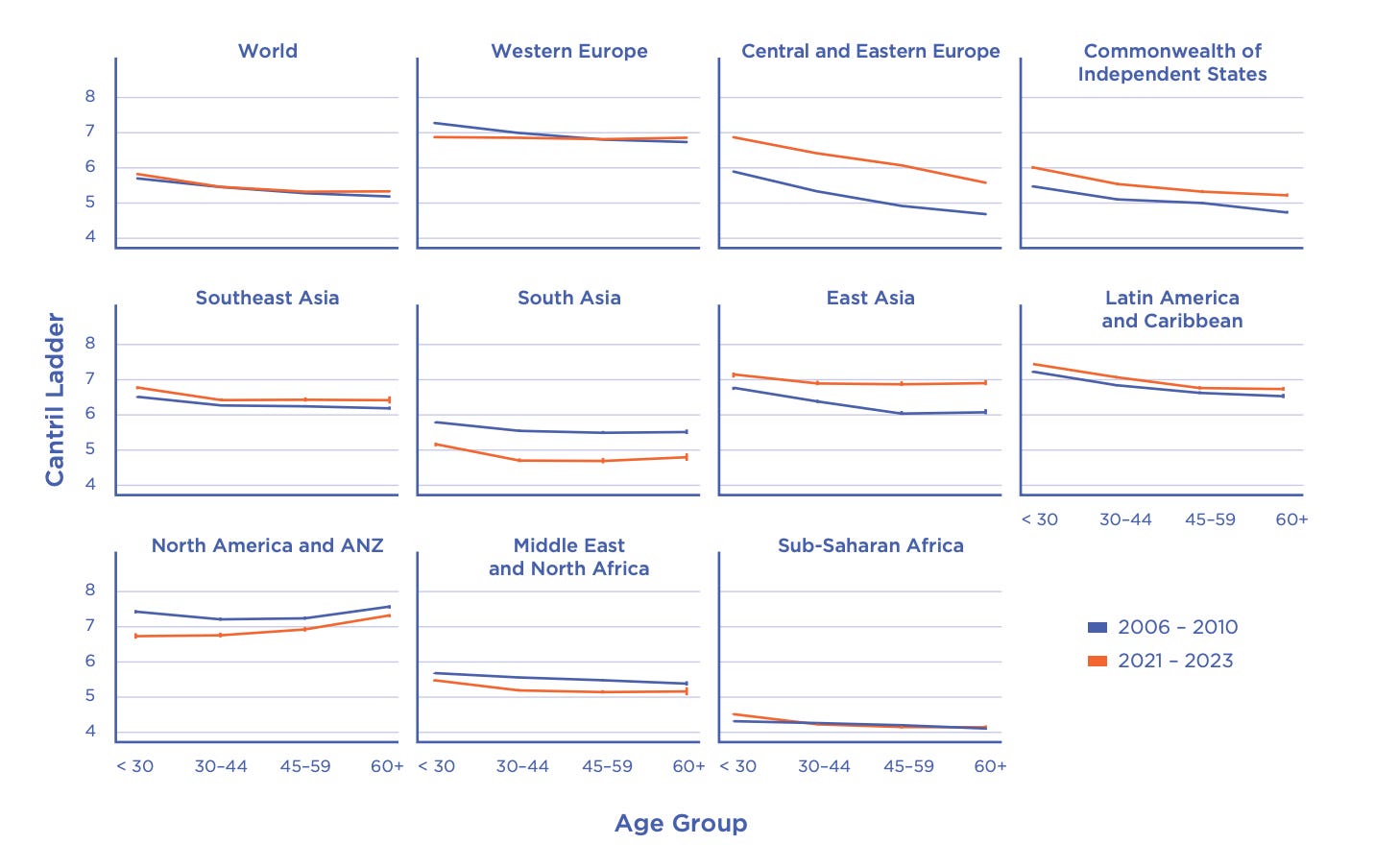
The reflexive response to a fact like this is to treat it as a malfunction. The inputs are obviously correct, so the output must be broken somewhere, and the job is to find the faulty component and swap it out. I want to suggest that this instinct, the reaching for the broken part, is itself the thing worth examining. Because the machine may be working exactly as designed, and the disappointment may not be a fault in it. It may be the point.
The Paradox Is Not a Malfunction
The report reasonably enough reaches for the nearest available culprit, which this year is the phone. The correlation is real and nontrivial. Heavy social media use tracks with lower wellbeing, the effect is sharpest among teenage girls, and the years in which young happiness fell off a cliff in the English-speaking world are precisely the years the feed went algorithmic. None of that should be waved away, and I am not going to waste your time pretending the device in your pocket is innocent.
The Addiction We Don’t Want to Name

Some years ago, while passing through Geneva, a city whose chief exports appear to be diplomacy, banking, and the subtle art of charging twenty francs for a sandwich, I found myself sitting in the lobby of a hostel. It was one of those transient places where backpackers, students, and assorted drifters of the international class briefly intersect before…
But social media is a proximate cause wearing the costume of a fundamental one. The feed is not a new kind of thing. It is the most refined instance of a very old one: a machine for deleting the discomfort of an unoccupied mind, available at all times, always carrying the next thing before you have finished the last. The phone did not invent the impulse to be spared your own company. It industrialised it. To stop the analysis at the phone is to mistake the most advanced instrument for the disease, and to leave the deeper question politely unasked. The deeper question is why a civilisation that has solved so many of the problems human beings actually have should produce, at the apex of its success, a generation that rates being alive lower than their grandparents do.
The answer, I think, is that we have been sold a particular theory of suffering, and the theory is wrong, and the wrongness is now coming due.
A Supply Problem That Was Never About Supply
The governing promise of modern life is that suffering is a supply problem. Whatever ails you is a deficit, and a deficit can be filled, and the filling can be bought. Discomfort is friction, friction is an engineering defect, and the entire apparatus of technology and commerce exists to sand it away. Every product is, at bottom, a small deletion: of effort, of waiting, of boredom, of inconvenience, and eventually of pain itself. The civilisational wager, never stated this baldly but operating underneath everything, is that if you delete enough of the negative you will arrive, by subtraction, at the positive.
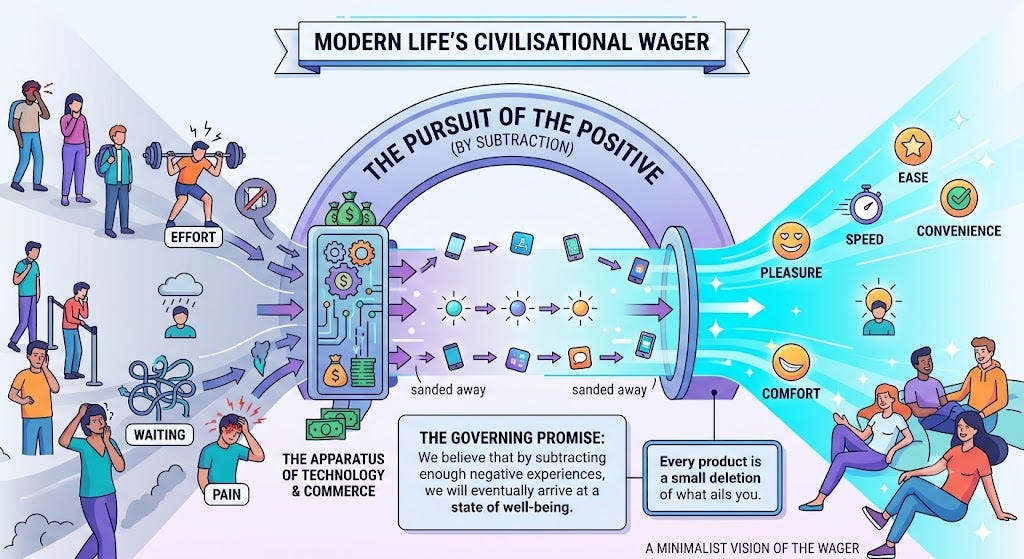
Let me concede the strong form of the objection immediately, because it is correct and because dodging it would be dishonest. Most of this deletion is real and a great deal of it is good. Anaesthetics are good. Antibiotics are good. The washing machine that handed women back their afternoons did more for human happiness than most philosophy. I am not nostalgic for cholera, and anyone who romanticises the friction of the past has usually never been on the wrong end of it. The deletion of pain is one of the few unambiguous achievements of the species, and I would not give back a single vaccine to recover some imagined nobility of suffering. Nor is any of this a smuggled brief for enduring what can be relieved. The Buddha, forever misquoted as a connoisseur of suffering, was nothing of the sort. The first thing he named was that living involves dukkha, and everything he said afterwards was aimed squarely at its cessation. He did not tell people to treasure their pain. He told them where he thought the way out was, and the way out was not for sale.
The error is not the deletion. The error is the category. We have taken a technique that works beautifully on pain and assumed it works on everything that hurts, as though pain and meaning sat on the same axis and could be addressed by the same machine. They do not, and it cannot. The things that actually frighten human beings at three in the morning are not deficits. They are not low on supply. The contingency of everything you love, the fact that any of it can be taken at any time and eventually all of it will be, the certainty of your own ending, the suspicion that you are wasting the only run you get, the sheer vertigo of being a self that has to choose and might choose wrong: none of these is a shortage. There is nothing missing. There is no part to order. A problem has a solution. A predicament can only be borne. The defining move of the modern West is to feed every predicament into a machine built for problems and to be quietly, chronically baffled when it comes out the other end unchewed.
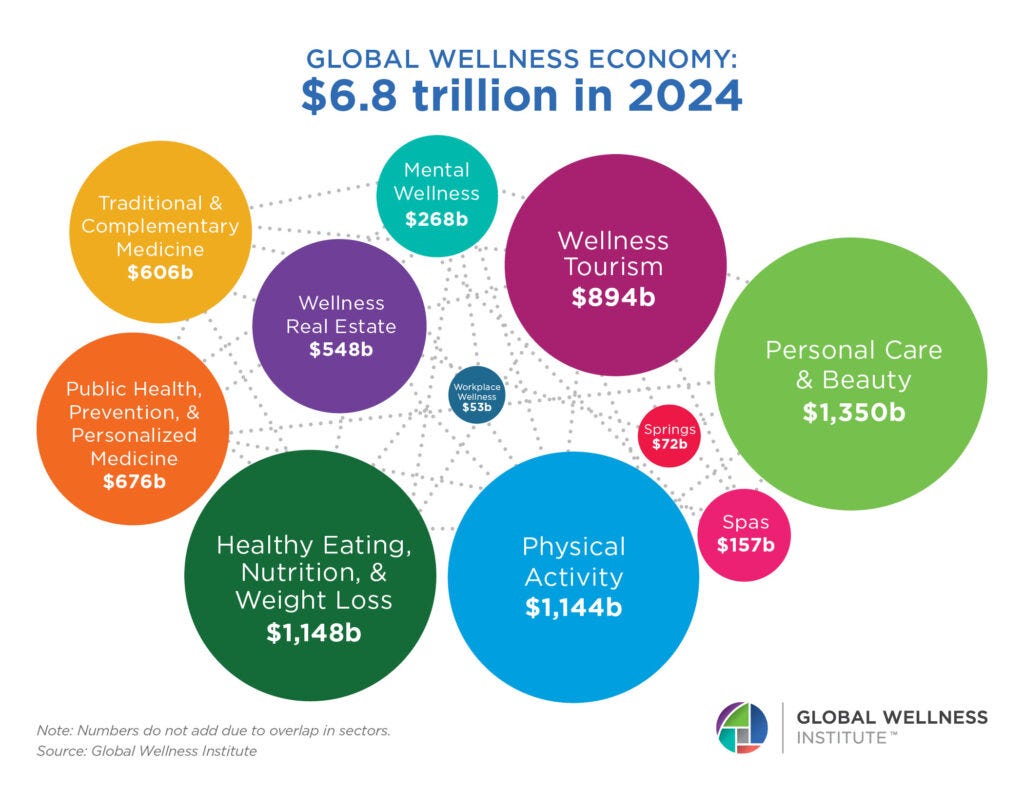
And the machine is enormous now. The global wellness economy reached 6.8 trillion dollars in 2024, having doubled in a decade, growing faster than the world economy it encompasses, and standing nearly four times the size of the entire pharmaceutical industry. Its fastest-growing wing is mental wellness. Meditation and mindfulness, packaged and sold, are expanding at close to a fifth a year. Pause on that. We have built a multi-trillion-dollar industry whose function is to sell, as a consumable, the inner peace that the rest of the economy spends its days disturbing. The promise has become recursive. First you are sold the friction-free life as the route to contentment, and then, when the contentment fails to arrive, you are sold the contentment separately, by subscription, as its own product. The cure and the disease now have the same address.
The Man Who Filed a Bug Report Against Death
If you want to see the logic of all this taken to its honest conclusion, you have to look at the person willing to follow it all the way down, and his name is Bryan Johnson.
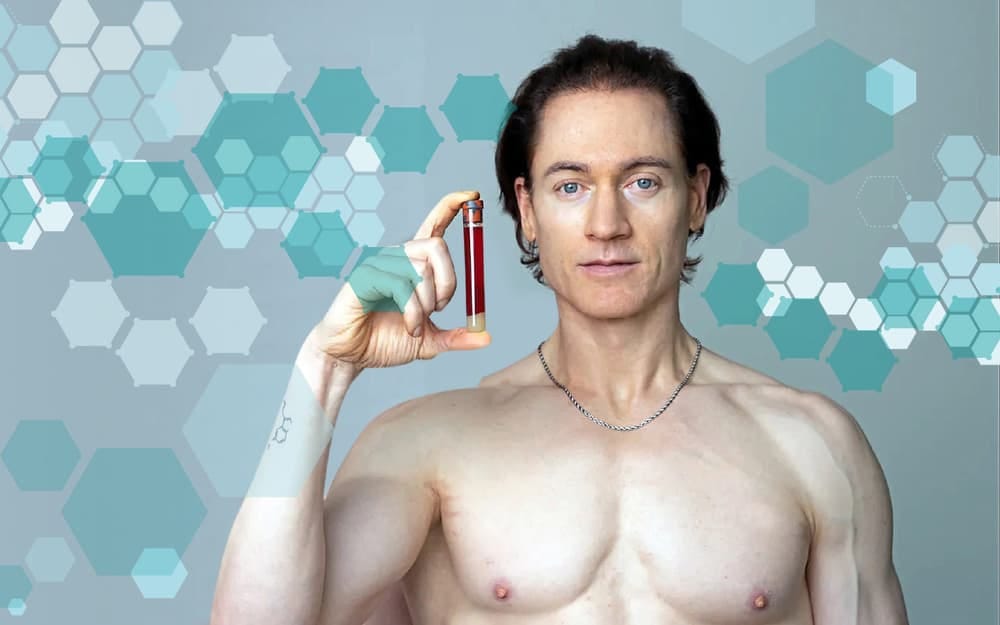
Johnson made his fortune selling Braintree, the company behind Venmo, to PayPal for $800 million. He has spent a meaningful slice of his cut, estimated at north of three hundred million, on a project he calls Blueprint, which, at its peak, ran to around two million dollars a year. The protocol is exhaustively documented and genuinely strange. He eats his last meal before noon, follows a strict vegan diet of measured grams, takes a rotating cast of supplements, tracks more than a hundred biomarkers, and goes to bed at half past eight every night without exception. For a period he received plasma transfusions, with his teenage son as one of the donors, until the data showed no benefit and, being more honest than most of the field, he stopped. He has given the self-destructive version of himself a name, Evening Bryan, the one who wants to stay up and eat, and he has formally revoked that man’s authority. He intends to live to 2140, which would make him 163.
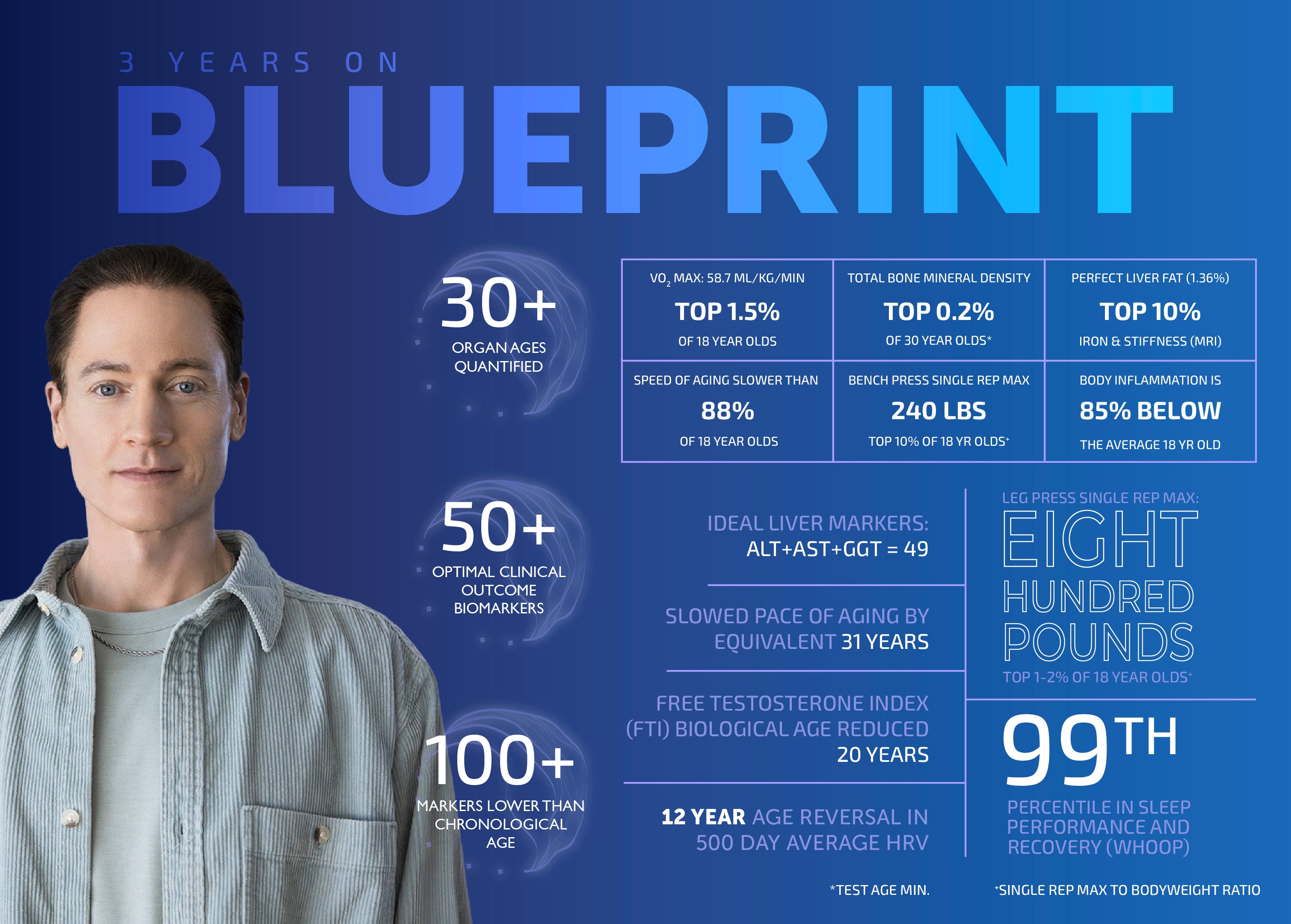
The philosophy has a name too, and the name is the whole argument in two words. It is “Don’t Die.” The stated aim, in his own framing, is to make death optional, to reclassify the oldest and most total of human predicaments as a defect that better engineering will eventually patch. There is a Netflix documentary. There is a marketplace. There is, of course, a range of supplements you can buy. And ask him what the extra century is for, and he does have an answer ready: he wants to be alive when superintelligence arrives, to see what the species turns into, to keep open every door that death would otherwise close.
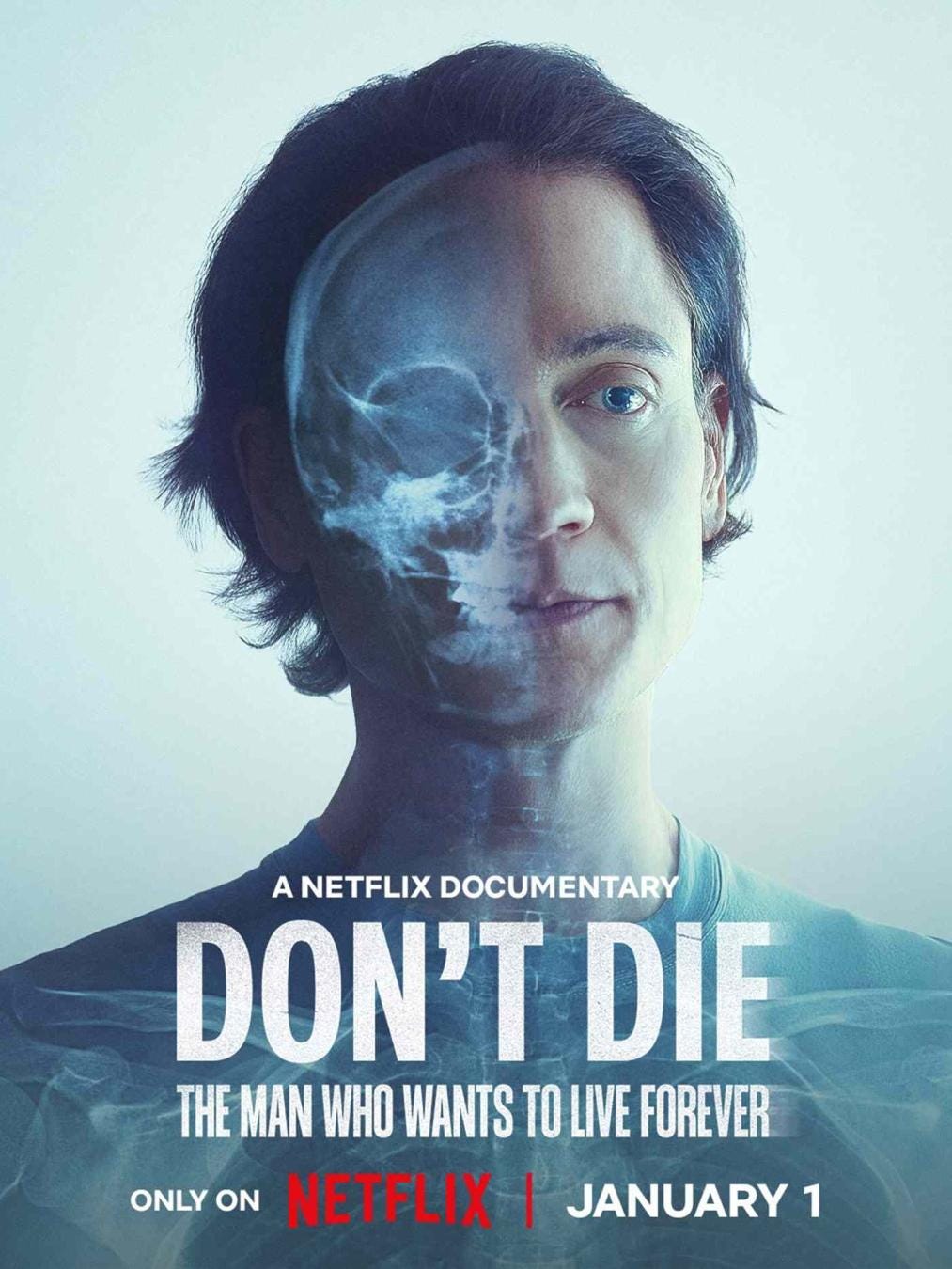
The temptation is to file Johnson under eccentric billionaire and move on, and that is exactly the wrong response, because it lets the rest of us off. Johnson is not an aberration from the culture. He is its most honest expression. He is simply doing out loud, with a bigger budget and no embarrassment, what the entire wellness economy does in a whisper. Every sleep-tracker, every longevity podcast, every cold plunge and continuous glucose monitor is a smaller, shyer version of the same gesture: the treatment of mortality as a problem of optimisation, a thing you can hold off indefinitely if you are only disciplined enough about your inputs. Johnson has the courage of the convictions that everyone else is hedging on.
And look closely at that answer, because it is the whole culture in miniature. To witness, to see what happens, to keep the doors open: this is the reasoning of a spectator, not a participant. It is a man buying a lifetime ticket to a show he has no intention of ever walking onto the stage of. There are metrics in the protocol for everything: resting heart rate, sleep stages, the biological age of individual organs, the firmness of his nighttime erections, all measured, charted, and relentlessly improved, and not one of them touches the question of what any of it is for beyond its own continuation. He has optimised the vehicle to a degree no human being in history has matched and pointed it nowhere in particular, on the reasonable-sounding grounds that nowhere in particular is where the interesting things will eventually turn up. Staying alive to see what comes next is not a purpose. It is the indefinite postponement of needing one, wearing the costume of curiosity. He has solved, or believes he has solved, every part of the question of life except the only part that was ever actually hard: what to do with the time.
And the fear has been aimed, without his seeing it, at a peculiar target. The future he is so afraid of missing, the arrival of a mind vastly greater than ours, is the one most likely to retire the entire human project of striving and mattering and being needed, his own included. He is keeping the vehicle in showroom condition so as to be present at the moment vehicles like his stop being the point of anything. The most disciplined man alive has aimed all his discipline at securing front-row seats for his own redundancy, and he calls this not dying. It is a strange kind of survival that consists of outlasting the reasons you once wanted it.
Strip away the language of superintelligence and open doors, and what is left is a frightened man with the means to do something about it.
Except the species settled this long ago, and its answer was the opposite of his. We are wired to hedge against our own deaths by making people who outlast us, and wired again to put them ahead of ourselves, to spend our bodies down on their behalf. It is the oldest machinery there is for holding a stake in a future you will not see, and it runs on accepting the erasure rather than fighting it: you bet on what comes after you by agreeing to become the after. Johnson has the money to attempt the one thing evolution never put on the table, which is continuation without replacement, and continuation without replacement is just the fear again, better dressed. That is not the quirk of an eccentric. It is the ordinary human case, fully funded, refusing the ordinary human terms.
What the Old Machinery Was For
None of this is a new diagnosis, and it would be dishonest to pretend otherwise. Half a century ago Ernest Becker built an entire book on the claim that every culture is, underneath, a machine for denying death, and that the trouble begins when the old machines stop convincing, and the species reaches for shabbier ones. The insight is not new. The new thing is the shabbiness of our particular replacement, and its price tag. The past was not happier, before anyone reaches for that objection; by almost every measure it was worse, and most people who pine for it are picturing themselves in the manor rather than the field. But it did possess something we have mislaid, and it was not happiness.
It was machinery for metabolising the predicament. Religion, whatever else it was, gave death a shape and a meaning and a set of words to say over the body. Fate, in its grim way, relieved you of the exhausting modern obligation to have engineered your own outcome. Ritual marked the passages so you did not have to face them alone or improvise them from scratch. Community meant your small terrors were absorbed into a larger story that did not end when you did, and the memento mori on the wall meant that mortality was a known houseguest rather than a stranger who breaks in at the end. None of this made the predicament smaller. It made it bearable, which is a different and more useful achievement.
The pattern shows up in the data, not just in nostalgia. Religious people, across a great many studies, report higher wellbeing than the non-religious, and the more devout tend to report more of it. Some of that is the company they keep, the congregation being one of the last functioning pieces of thick community left standing, and the honest version of the claim has to concede that the belief and the belonging are hard to prise apart. But part of it is the thing itself. There is a documented lightness that comes from surrendering authorship: hand the wheel to a higher power and you are relieved, at a stroke, of the exhausting modern duty to have engineered your own outcome, and relieved too of sole liability when it goes wrong, because the fault can be devolved upward to providence or outward to the adversary. It is the exact inverse of the condition we have built for ourselves, in which each person is the sole author of a life, the sole executive of its every outcome, and the sole defendant when it fails.
A great deal of that machinery was also false, and cruel, and built to keep the wrong people in their place, and we were right to take much of it apart. I am not arguing for its return. I am pointing out what happened when it went. The predicament did not leave with it. Mortality and contingency and the weight of being a self do not depend on belief; they were here before the cathedrals and they outlasted them. What we did was to remove the dressing and leave the wound, and then, finding the wound still open and weeping, we went out and bought a more expensive, beautifully designed dressing that does not adhere to anything. A product can carry your voice across an ocean. It cannot carry a death. We asked it to anyway, and we are surprised it buckled.
Convenience Is a Kind of Deskilling
There is a further turn of the screw, and it is the part I find genuinely frightening rather than merely sad.
Convenience is sold to us as liberation, and at the level of any single transaction that is what it feels like. The car arrives, the food arrives, the answer arrives, the next episode begins before you have decided you want it. But convenience does something underneath the liberation that nobody advertises, because it would not sell. It deskills you. The capacities that allow a human being to bear existence are not innate gifts; they are muscles, and like all muscles they exist only insofar as they are used. The ability to sit in discomfort without immediately reaching for relief. The tolerance of boredom long enough for a thought to actually form. The patience to make something slowly and badly before making it well. The capacity to be unstimulated, unentertained, alone with yourself, and not flinch.
We have spent twenty years and an extraordinary amount of money, and the best engineering talent of a generation, building an environment scientifically optimised to ensure that none of those muscles ever has to fire. The discomfort is intercepted before you feel it. The boredom is filled before you notice it. The marshmallow test has been run in reverse: we have constructed a world that presses the marshmallow into your hand before you have even registered the wanting, and then we diagnose the resulting weakness as a personal failing and sell you a course to fix it.
This is also where the timing fits, and timing is the part the convenience story usually fumbles. Labour-saving has been arriving for a century: the washing machine and the car and the dishwasher, and for most of that span the frictions it removed were physical, which is why its effect on the inner life was real but slow and diffuse, a gradual softening rather than a cliff. What changed around 2010 was that the deletion finally reached the last frictions that were not physical at all: boredom, solitude, the unfilled minute, the stretch of unstimulated time in which a person is left alone with their own mind. The phone did not open a new front. It completed the old one. It automated away the inner inconveniences the washing machine had never been able to touch, and it did so in exactly the years the youth curve broke. That is why social media shows up so strongly in the data and still is not the deepest cause; it is the mechanism through which a much older project finally finished the job.
And it is why the young are the worst hit. The grandparents rating their lives above their grandchildren were not handed better lives; they were handed harder ones, and the hardness built the equipment, teaching them, because nothing gave them the choice, how to wait and how to be bored and how to sit with a bad afternoon until it passed. The young were deskilled from birth, raised inside an environment that intercepted every discomfort before it could become a teacher, and they are now asked to carry the full weight of being alive with faculties that were never permitted to form. They are not weaker people. They were handed a frictionless world and then blamed for having no calluses.
And calluses, unlike software, cannot reliably be installed at thirty. The capacity to tolerate being alive is laid down early, in the boring afternoons and the unsupervised hours and the long stretches with nothing to do but become someone, and a generation that was never given those may reach adulthood to find the muscle does not answer when it is finally called. That is the genuinely bleak possibility underneath the cheerful talk of resilience and digital wellbeing. It is not that the young are temporarily soft and will toughen up. It is that the equipment for bearing existence has a fitting window, the window appears to have been missed at population scale, and nobody has ever demonstrated that it can be reopened.
You Cannot Buy the Exit
The natural place to land an essay like this is on a recommendation, and I can feel the gravity of it pulling: consume less, be present, put the phone down, embrace a little wholesome friction. The trouble is that all of that is already for sale. Minimalism is a product, retailing at three hundred pounds for the right linen shirt and a decluttering consultant to tell you which of your possessions spark joy. Digital detox is a premium retreat. The embrace of friction has been packaged into a sourdough starter and a cold plunge and a subscription. You cannot buy your way out of a wound that was caused by believing you could buy your way out of things. The exit is the one item the shop does not stock, precisely because the shop is the problem.
So I will not pretend there is a purchase that fixes this, because the belief that there is a purchase is the disease itself. What there is, instead, is a thing to stop doing, and it is harder than any product because it cannot be acquired, only relinquished. The assumption is that fear is a malfunction. The existential risk is not a bug in the human condition that better technology will eventually resolve. It is the admission price. It is what you pay to be the kind of creature that can love anything at all, because the dread of loss and the capacity for attachment are not two things; they are one nerve, running in both directions. The small private lurch you feel watching someone you love sleep, the thought that this could one day be taken, is not the opposite of the tenderness in that moment. It is the same signal, read from its other end. Anaesthetise the fear of losing what you love, and you will find, too late, that you have numbed the loving along with it. A life spent successfully deleting the risk is a life that has quietly switched off the current that made it worth living, and called the silence peace.
And there is no reward for seeing this, which is the part the genre always flinches from. Understanding it does not make you happier. It does not convert the friction back into meaning by some clean spiritual alchemy, and it does not make the ache lift. The most it offers is the end of being surprised by the ache, the small grim relief of no longer waiting for a cure that was never coming. You do not get peace. You get to stop being lied to, mostly by yourself. A culture built entirely around deletion will always find that an insulting offer, because it cannot be bought, cannot be optimised, cannot be subscribed to, and can never, in the way this culture means the word, be finished.
Bryan Johnson goes to sleep at half past eight every night, on schedule, having banked another flawless day against a future he has measured to the decimal and declined to define. The horror of him is not that he is strange. It is that he is us, rendered at full scale, with the budget to take the bet seriously and the nerve to say the quiet part. And the under-25s now rating their lives below their grandparents are the same bet seen from the other end, the first cohort raised entirely inside the finished machine, reporting back the one result the brochure never listed. The rest of us run the version in between, every evening, optimising the inputs, tracking the sleep, intercepting the boredom, smoothing the friction, adding careful days to a life we are increasingly too distracted to be present for, and lying awake afterwards in the richest and most frictionless dark in human history, waiting for the rest of the order to arrive.
It is not going to arrive. This was the whole delivery. The life with the friction taken out was never the thing standing between us and contentment; it was the thing we were sold instead of contentment, and it came exactly as described, on time and to specification. The machine did not fail us. The machine never fails. It does precisely what it promised, which is to remove everything that can be removed, and it turns out that what is left when you have removed everything that can be removed is a person lying awake in a clean, quiet, beautifully engineered room, holding the only product they were ever guaranteed, which is the unedited fact of being alive, and discovering at last that this was the thing the whole apparatus had been built to help them avoid.
☕ Love this content? Fuel our writing!
Buy us a coffee and join our caffeinated circle of supporters. Every bean counts!
Another good article! I am strange, I think. I look for challenges – whether writing, -always a puzzle- or training dogs and horses. Not happy without some problem to solve. I pay no attention and give zero credence to the ‘wellness’ industry. To speak (too?) plainly: Bryan Johnson is an idiot – who wants to live forever? It’s hard to get old, and all his plans will not prevent that chronic illness waiting round the corner. As you say, so aptly, a predicament can only be borne. And I am learning that the hard way as we speak.