

The Sequel Machine
How Hollywood quietly stopped making things up

I was three episodes into The Boys before I realised what was bothering me about it, and the thing that was bothering me was not on the screen. It was the small, slightly humiliating realisation that I could not remember the last time I had watched something on a major platform that felt like it had been made by people genuinely trying to surprise me. Not surprise me with a twist, or a bigger explosion, or a clever reshuffling of an existing intellectual property into a slightly different shape. Surprise me with the basic fact of its existence. Surprise me by being a thing that did not, until very recently, exist in any form at all.

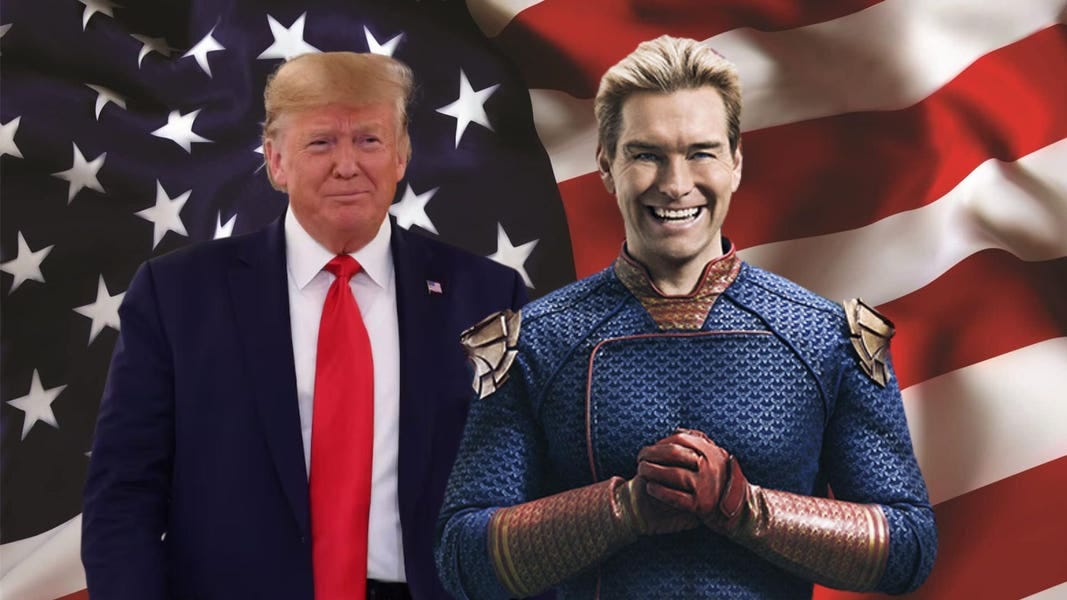
The Boys is, on paper, a superhero show. This is the genre we have collectively been pretending to enjoy for fifteen years, the way one pretends to enjoy a colleague’s wedding speech. The cinema has been so saturated with capes that the word “superhero” now describes less a category of fiction than a delivery mechanism for quarterly earnings. And yet here was a show that took the entire apparatus, the powers, the costumes, the brooding, the city in peril, and used it to ask the question every Marvel film has spent two decades carefully avoiding: what if the people with godlike powers were exactly the kind of people who, in real life, tend to end up with that much power? What if they were vain, and stupid, and corporate, and frightened, and the corporation that owned them was worse?
Then I started looking into the numbers, and the numbers are a great deal worse than the vibes.
The numbers, briefly, in case you thought this was nostalgia
In 2025, nine of the ten highest-grossing domestic releases came from existing intellectual property. The single original title to crack that list was Warner Bros.’ Sinners. The other nine were sequels, prequels, remakes, live-action redos of animated films, or new instalments in cinematic universes that have been running long enough to qualify for a long-service award. And lest you imagine this is a temporary aberration, an industry between bets, 2026 is set to eclipse 2025 in terms of the number of high-profile sequels and known IP on the slate: a third Avatar, a fifth Toy Story, a live-action Moana, Avengers: Doomsday, another Spider-Man, the first theatrical Star Wars film since 2019, a third Dune, a Supergirl, a third Minions, a Super Mario sequel, and a Hunger Games prequel, all jostling for the same multiplex screens.
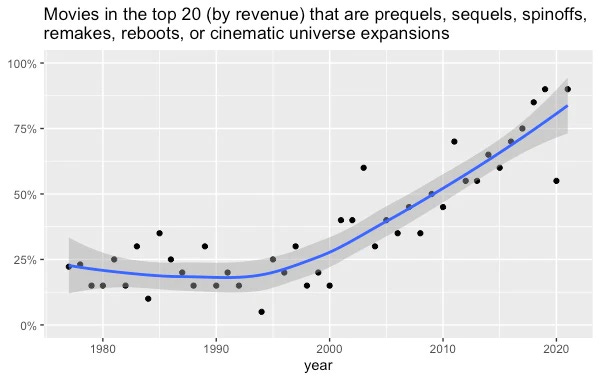
The structural picture is even bleaker than the headlines. By one industry analysis, in 2019, the 42% of wide releases that were franchise films earned 82.5% of Hollywood’s worldwide box office, while the 58% that were non-franchise originals took 17.5%. Read that sentence twice. The original films accounted for the majority of what was made, and they were a rounding error compared to what was earned. The sequels were the minority of what was made, and they were almost everything. This is not a market signal. This is a market collapse.
The natural response, the one Hollywood reaches for whenever this comes up, is to say: well, that is what audiences want. People are voting with their wallets. The market has spoken. This is one of the great rhetorical sleights of the entertainment business. The market has not spoken. The market has been handed a menu with 47 variations of chicken and then congratulated for ordering chicken.
What the menu actually represents is a slow process of getting worse, the kind that happens when a system optimises itself so thoroughly for its own internal metrics that it loses the ability to do what it was originally for. There is a useful word for this. The word is enshittification. The films are no longer being made for the people watching them. They are being made for the executives who commission them, the algorithms that promote them, the analysts who model their box office performance, the shareholders who want predictable returns, and, finally, almost as an afterthought, for the people in the seats. The viewer has become a downstream variable in a spreadsheet about something else entirely.
Enshittification
Definition: when a digital platform is made worse for users, in order to increase profits
The man who killed the rabbit
To see how this works at the level of an actual decision by an actual human being, you do not need a hypothetical. You need David Zaslav.

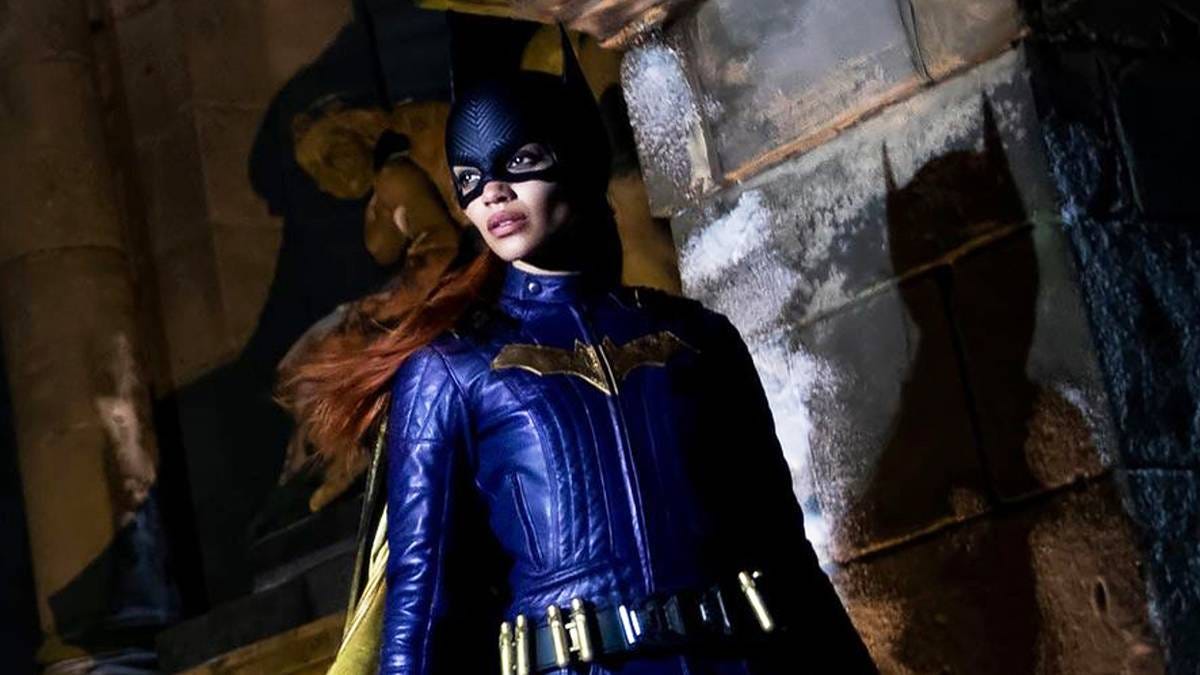
In August 2022, shortly after taking over the newly merged Warner Bros. Discovery, Zaslav cancelled a finished film. The film was Batgirl; it had cost roughly $90 million, had been shot and edited, and was awaiting release on the company’s streaming service. It was scrapped. Not delayed. Not retooled. Scrapped, in the sense that it would never be seen by anybody, ever, because the value of the tax write-off the company could take by pretending the film did not exist was greater than the value of releasing it. The directors had to find out from the trade press.
Fifteen months later, in November 2023, the same studio did it again to a film called Coyote vs. Acme, a hybrid live-action and animated Looney Tunes feature directed by Dave Green and produced by James Wan. The production had cost around $70 million. Test audiences had given it scores fourteen points above the family-film norm. Phil Lord and Chris Miller, who had seen it, called it brilliant. Will Forte, one of its stars, advocated publicly for its release. Zaslav cancelled it anyway, reportedly without ever having watched it himself, and took the write-down.
When asked about these decisions at a public conference, Zaslav said it had taken “real courage” to cancel the films. He used the word courage. About killing finished movies for tax purposes. The man was not joking. He was, in his own mind, the brave one in the story.
Hold that image for a moment, because it tells you almost everything you need to know about how the industry currently works. A finished film with positive test scores, a recognised brand attached to it, an existing audience, a director and a crew who had spent years on it, was killed because the abstract financial benefit of pretending it had never existed exceeded the abstract financial benefit of letting people watch it. The cultural product was less valuable than its absence on the balance sheet. There is no version of this calculation in which the audience appears as a real consideration.
And here is the part that should make you angry. While Warner Bros. was killing Coyote vs. Acme, it was simultaneously developing a new Game of Thrones spinoff called Aegon’s Conquest, intended both as a TV show and as a “Dune-sized feature film”. The studio that did not have $30 million to release a finished, well-tested, original family comedy had a limitless appetite for the eighth instalment in a fantasy franchise. The internal logic is perfectly consistent. The internal logic is also exactly what is killing the thing.
Enshittification does not look like cynicism from the inside. It looks like prudence. It looks like the courageous thing to do.
The arithmetic that ate the imagination
Zaslav’s particular sins are easy to single out, but he is not an outlier. He is the visible expression of an arithmetic that now governs every studio in the business, and that arithmetic deserves a moment of patient attention because it explains why none of this is going to fix itself.
A modern franchise blockbuster runs to around $250 million in production budget and another $150 million or so in global marketing. By the time the lights go up at the premiere, the studio is already $400 million underwater, before a single ticket has been sold. Recovering that money does not require a hit. It requires a phenomenon. It requires opening simultaneously in 70 countries, holding the top spot for 3 weekends, generating enough merchandise revenue to keep a small nation in plush toys for a decade, and seeding 3 sequels and a streaming spinoff as well. The number of films capable of doing this in any given year is somewhere between four and seven, depending on how the wind blows.
Now consider what this does to the risk profile of every other film a studio might make. Once you are routinely committing $400 million to a single theatrical bet, anything smaller starts to look not merely uninteresting but irresponsible. A $50 million original drama, even if it triples its budget, contributes a rounding error to the annual results. A $250 million franchise instalment, even if it merely meets expectations, contributes an entire quarter. The executive who greenlights ten interesting mid-budget originals and gets eight modest hits has built a smaller, healthier, more variegated slate. The executive who greenlights one Avengers film has hit her number for the year and goes home. Guess which one gets promoted.
This is the trap. The budgets did not get this big because the films had to be this big. They got this big because once you commit to the franchise model, you can only justify the underlying investment by spending on a scale that makes any creative risk look indefensible. The budget itself becomes an aesthetic decision, and the aesthetic it produces is the one we are now drowning in: enormous, four-quadrant, lore-heavy, internally consistent, and nearly impossible to remember three days later. You cannot put a delicate, ambiguous, formally adventurous film on a $300 million budget. You can only put a Doctor Strange in the Multiverse of Madness on it, and once you have done that, the cultural slot it occupies is taken.
The shrinking room
If the budget arithmetic explains why each individual decision tilts towards the safe bet, the consolidation of the industry explains why those decisions are now being made by a vanishingly small number of people. The list of companies capable of greenlighting a major film has been shrinking steadily for thirty years, and the shrinking has just accelerated.
The “Big Six” of the studio era consolidated to a “Big Five” after Disney’s acquisition of 21st Century Fox in 2019. The Big Five is now in the process of becoming the Big Four, or possibly the Big Three. As of March 2026, the finalised $170 billion merger between Paramount and Warner Bros. Discovery has redrawn the global media landscape, with the combined entity controlling DC Comics, HBO, Star Trek, Mission: Impossible, and Harry Potter, as well as more than 200 million streaming subscribers. The trade body representing American cinemas warned regulators that combining the two would consolidate as much as 40% of each year’s domestic box office in a single studio, and that studio consolidation historically leads to fewer movies being made. They were ignored. They are always ignored.
There is a particular kind of cultural impoverishment that happens when the number of independent decision-makers in an industry drops below a certain threshold, and we are now well below it. It is not that the executives at Disney, Comcast, Paramount, and Skydance are stupid, or philistine, or actively hostile to interesting work. Most of them are intelligent people who, in another life, would have happily commissioned the kind of films their studios used to make. The problem is that a tiny handful of decision-makers, drawing on the same instincts about what works, optimising for the same handful of metrics, are now making nearly all the decisions about nearly all the visual culture the rest of us consume. The variance has been engineered out of the system. You cannot get a weird film made because there is no longer anyone weird left to greenlight it. The eccentrics have all been bought, fired, or absorbed into a vertical integration strategy.
This is what consolidation actually means in cultural terms. Not censorship, which is too crude a word. Something subtler and more thorough. A narrowing of the imaginative bandwidth of an entire civilisation, conducted through entirely rational corporate decisions, each defensible in its own terms, none of which anyone individually chose to make.
The television problem, which nobody is allowed to discuss
It would be easy, at this point, to say: well, fine, the cinema is broken, but at least we have prestige television. This was the consolation prize the industry kept offering throughout the 2010s, and a great many people, myself included, accepted it. Cinema had become the franchise machine. Television had become the place where the actual writers were going. The Sopranos, Mad Men, Breaking Bad, Better Call Saul, The Wire, Succession. For about fifteen years, there really was a parallel ecosystem in which interesting work was getting made by interesting people for viewers who paid attention. The bargain seemed acceptable. We gave up the mid-budget adult drama at the cinema, and we got it back, in serialised form, on a screen at home.
That bargain has now collapsed, and the collapse is following exactly the same logic as the collapse at the cinema, just a few years behind.
Consider what HBO did to Game of Thrones. The original series ended badly in 2019. What followed was not the dignified release of a creative team to go and make something else, but the immediate construction of an industrial pipeline. House of the Dragon arrived as the first prequel, then A Knight of the Seven Kingdoms as the second, with seven further spinoffs in various stages of development at one point, including animated series about Aegon’s Conquest, the voyages of Corlys Velaryon, the migration of Nymeria and the Rhoynar, and assorted other corners of the lore. The fantasy universe of one moderately successful novelist has been turned into a perpetual content mine, the way an oil field is turned into a perpetual extraction operation. Every named character with a backstory is a potential spinoff. Every battle mentioned in passing is a potential six-episode arc. There are now adults whose entire full-time job is to figure out how to keep producing more Game of Thrones until either the audience or the underlying intellectual property gives out, and the smart money is on the audience giving out first.
This is not unique to HBO, nor to fantasy. Big Little Lies was sold as a closed, seven-episode adaptation of a single novel. Then it became a second season that the cast did not really want to make. Mare of Easttown was a contained, brilliant limited series. It is now reportedly being developed for a second season, a show that explicitly did not need it. The White Lotus was so emphatically a one-off that the title referred to a single hotel; it is now an anthology franchise that will continue until Mike White either dies or emigrates. Squid Game was a bleak, formally complete satire whose entire point was that the game ended; the second season existed only because Netflix could not bear to leave a successful intellectual property on the table, and it was forced to betray the moral arithmetic of the first season in order to justify its own existence. The show became, in its sequel, an advertisement for the thing it had originally been a critique of. The algorithm does not care about this contradiction. The algorithm cannot read.
The deeper rot is that the limited series, which was supposed to be the format that protected interesting work from the franchise instinct, has been quietly redefined as a marketing term. A “limited series” is now any prestige drama whose first season is allowed to look complete and self-contained until the viewing figures come in, at which point its limitation is reconsidered. The form that promised closure has become a delivery mechanism for the open-ended sequel. There is no escape into a different format because the same logic that turned films into franchises has now turned television into franchises, just with more episodes and slightly better writers, for now.
Streaming, which was supposed to fix all of this
The cruellest joke in this whole story is what happened with the streaming platforms. There was a moment, somewhere around 2015, when it genuinely looked as though they were going to be the escape route. They had no theatrical windows to defend, no merchandising arms to feed, no toy companies to placate. They were spending money like sailors on shore leave, commissioning shows from anyone with a pulse and a pitch deck. The Crown, Stranger Things, Fleabag, Succession. For about five years, television was where the interesting work was happening, paid for by venture-capital logic and the assumption that subscriber growth would never stop.
It stopped. The platforms looked at their balance sheets and discovered, to their apparent surprise, that the audience for genuinely original work was smaller and more fickle than the audience for things people already knew. And so the streamers, structurally now in exactly the same position as the studios, became the most enthusiastic sequel-merchants of all. Netflix spends more on acquiring established intellectual property than any traditional studio. Amazon owns the rights to The Lord of the Rings and is grinding out television adaptations of it with the joyless efficiency of a regional council processing planning applications.
Streaming platforms spent a combined $42 billion on content in 2025, and much of it went into making more of what already existed. They have shareholders. They have content budgets that have to be justified quarterly. They have algorithms that tell them, with terrifying precision, that subscribers are markedly more likely to click on something with a familiar title than something with an unfamiliar one. The algorithm is right, in the narrow, immediate sense in which algorithms are always right. And the algorithm is hollowing out the thing it was meant to protect.
The Boys, incidentally, lives on Amazon Prime, and is one of the shows Amazon points to when it wants to remind you that it can still commission interesting work. It is also, tellingly, almost the only one. For every Boys there are nine Rings of Powers, each a calculated bet on a known quantity, each strangling the thing it claims to honour.
The parallel cinema in your pocket
If you want to see what happens to the genuine creative impulse when the official channels close, look at YouTube. Look, specifically, at a channel called Defunctland. It is run by a man called Kevin Perjurer, and what he makes are feature-length documentaries, with original archival research and on-camera interviews, about the corporate histories of failed theme parks. That sentence sounds like a joke, but it is not. His documentary on the history of Disney Channel runs to nearly two hours, has the structural ambition of a BBC Four commission from the era when BBC Four still made things, and has been watched by tens of millions of people. It exists entirely outside the studio system. It costs roughly nothing to make. It is better than most of what HBO has aired in the past five years, and it is better because the man making it does not have to answer to anyone except his audience, which is the only constituency that has ever produced good work in the entire history of cinema.
Defunctland is one example. There are thousands. And the honest response to that claim is: yes, and there are also millions of terrible ones, because YouTube is subject to precisely the same algorithmic incentives that ruined the studios, just at a different scale. The platform rewards consistency, frequency, and recognisability. Its recommendation engine, like Netflix’s, pushes viewers towards the familiar. The most successful YouTubers are, in their own way, franchise operators: they have found a format that works and they repeat it with minor variations, indefinitely, because the algorithm punishes deviation. MrBeast is not experimenting. He is running a formula with the discipline of a Six Sigma consultant. The trash-to-signal ratio on YouTube is, if anything, worse than on the streamers. Ninety percent of what gets uploaded is unwatchable, and the platform does not care, because the platform is not in the business of quality. It is in the business of attention.
And yet. The difference, the one that matters, is not about the average quality of what gets made. It is about who gets to decide. On YouTube, the money flows directly to the person who made the thing. Not much money, in most cases, and extracted through an advertising model that is itself a kind of tax on the viewer’s patience, but the structural relationship is different in a way that has consequences. A studio executive who greenlights a film is spending someone else’s money and will be judged on the quarterly results. A YouTuber who makes a two-hour documentary about the history of Disney Channel is spending her own time, answering to no one, and if it fails, the only person who absorbs the loss is her. This means the incentive to take risks, while not universal, is at least possible. The ceiling is lower. But the floor for experimentation is also lower. Nobody has to approve the weird thing before it exists. It just exists, and then the audience finds it or it doesn’t.
This is, on one hand, a kind of cultural triumph. The means of production have been democratised in a way the avant-garde of the 1970s could only have dreamt about. The gatekeepers have been routed.
It is also a sign of just how badly the official system has failed. We have not democratised cinema. We have bifurcated it. At the top, an ever-smaller number of ever-larger studios produce an ever-narrower range of ever-more-expensive franchise instalments. At the bottom, an enormous number of creators, most of them mediocre and a few of them extraordinary, make work for platforms that pay them in fractions of a penny per view and own the audience relationship absolutely. The middle, where most of the great films of the twentieth century actually came from, has been hollowed out and paved over. YouTube did not replace it. YouTube is what grew in the rubble.
What is actually being lost
The argument is not about taste. It is not about whether Avengers: Doomsday is more or less artistically valuable than Annie Hall. The argument is structural and about variance.
A culture that produces an enormous range of things, most of them mediocre and a few of them extraordinary, is healthier than a culture that produces a small number of things, all of them competent and none of them transcendent. The first culture is the one that gives you 2001: A Space Odyssey, Apocalypse Now, Eternal Sunshine of the Spotless Mind, and Parasite, almost as accidents, in between all the rubbish. It produces these films not because some genius committee identified them in advance but because the underlying ecosystem was making enough different bets, with enough different sensibilities, in enough different rooms, that the lightning had places to strike. The accidents are the point. You cannot have the Eternal Sunshines without also having a hundred films that nobody remembers. The hundred films that nobody remembers are not a waste. They are the substrate.
The second culture is the one we are now inside. It is professional. It is well-marketed. It is internally consistent. It hits its quarterly numbers. It produces nothing that, twenty years from now, anyone will actually remember, because remembering requires the kind of formal risk that the system has been engineered to eliminate. The blockbusters of 2026 will be forgotten by 2030, and the blockbusters of 2030 will be forgotten by 2034, and the only films from this entire era that will survive will be the rare original works that snuck through the system by accident, and the YouTube documentaries that nobody currently considers cinema but that historians will eventually recognise as the actual creative output of the period. The films Hollywood is spending $400 million each to produce will turn out to have been a kind of expensive cultural noise, indistinguishable from one another, from what came before, and from what comes after.
This is the loss. Not bad films. Plenty of eras produced bad films. The loss is the absence of the conditions under which great films could even occur.
The part where you come in
I keep coming back to The Boys, and I think it is because the show is doing something almost unbearably on-the-nose. It is, ostensibly, a satire of superheroes. What it is actually a satire of is the corporate machinery that produces superhero entertainment. The villain of The Boys is not really Homelander. The villain is Vought International, the mega-corporation that owns him, markets him, decides which version of him the public is allowed to see, and has a meeting about whether his cape should be three per cent more red. Vought is a parody of every conglomerate that has spent the past two decades turning culture into a yield curve. And the joke is that Amazon paid for it, presumably because somewhere in Seattle, a mid-level executive looked at the spreadsheet and concluded that there was a profitable demographic for shows about how terrible their own employer was. Then Amazon commissioned another nine seasons of Rings of Power, because the spreadsheet is the spreadsheet, and one Boys is enough to keep the critics quiet.
It is worth saying, at this point, that none of this is unique to cinema. This is what every industry does when it consolidates. Restaurants become chains. Phones become rectangles. Holiday destinations become resorts. The logic is always the same: optimise for the median, shave away the variance, let the margins fend for themselves. The franchise-ification of film and television is not a cultural crisis unique to the screen. It is the same process that turned every high street in every city in every wealthy country into an identical parade of the same twelve brands, applied to the thing we used to call art. The only difference is that when a restaurant chain replaces a neighbourhood bistro, nobody pretends the breadsticks are a creative achievement.
Which brings me, finally, to you. Because this essay has been written as though Hollywood is the villain and you and I are the helpless witnesses, and that is the comfortable framing, but it is not the true one. The reason the franchise machine works is that we keep feeding it. Every time the trailer for the third Avatar drops, and you think, well, I’ll see it for the spectacle. Every time you click on the new Marvel show, it's on the front page because the algorithm puts it there, and you have had a long day. Every time you choose the comfortable known thing over the uncomfortable unknown thing, which is most evenings, for most of us, including me. The studios are not making this stuff in defiance of audience preference. They are making it in perfect, granular, algorithmic alignment with what we actually do, which is not the same as what we say we want. The revealed preference of the western viewing public, expressed in billions of micro-decisions per night, is for the thing they have already seen, slightly louder.
This is the part of enshittification that is hardest to talk about, because it implicates the user. The platforms get worse because they are optimising for what we actually click on, and what we actually click on is, much of the time, the worst version of what we say we want. The Boys exists because somebody fought for it. The next Boys will only exist if enough people watch the genuinely strange and unfamiliar thing the first time it appears, instead of waiting for the sequel.
The next Marvel film comes out in December. The one after that is already in pre-production. The third is being storyboarded. The fourth is a gleam in an executive’s spreadsheet. None of them will be as interesting as The Boys, and all of them will make more money than it ever did, and the lesson the studios will draw from this is the one they always draw.
Make more of what already worked. The audience, after all, has spoken.
The question is what you say next.
☕ Love this content? Fuel our writing!
Buy us a coffee and join our caffeinated circle of supporters. Every bean counts!
Good observations. I do think Apple is making some rather clever, innovative, and good tv. Often, it seems with greater attention to quality than returns. Of course, this is likely just a way to get people to subscribe to their services.
Thank you for this clear articulation about the current state of mainstream Hollywood.