

The Enemy We Decided to Keep
For most of our history the danger arrived from outside. We won. The danger now is the winning.

There are two freezers in the world that still contain smallpox.
One sits at the Centres for Disease Control in Atlanta. The other sits at a research centre called VECTOR in Koltsovo, a town near Novosibirsk in the Russian half of the calculation. The virus inside them is variola, kept in liquid nitrogen, and it is the closest thing our species has ever had to a perfect enemy. Smallpox killed roughly three hundred million people in the twentieth century alone, more than every war of that century combined. It killed around three in ten of the people it infected and disfigured most of the survivors. It had no agenda and no mercy, and it had been doing this to human beings for at least three thousand years. Then we beat it. The World Health Assembly declared the disease eradicated in 1980, the last person to catch it naturally having done so in Somalia in 1977. It is the only human disease we have ever driven to extinction in the wild.
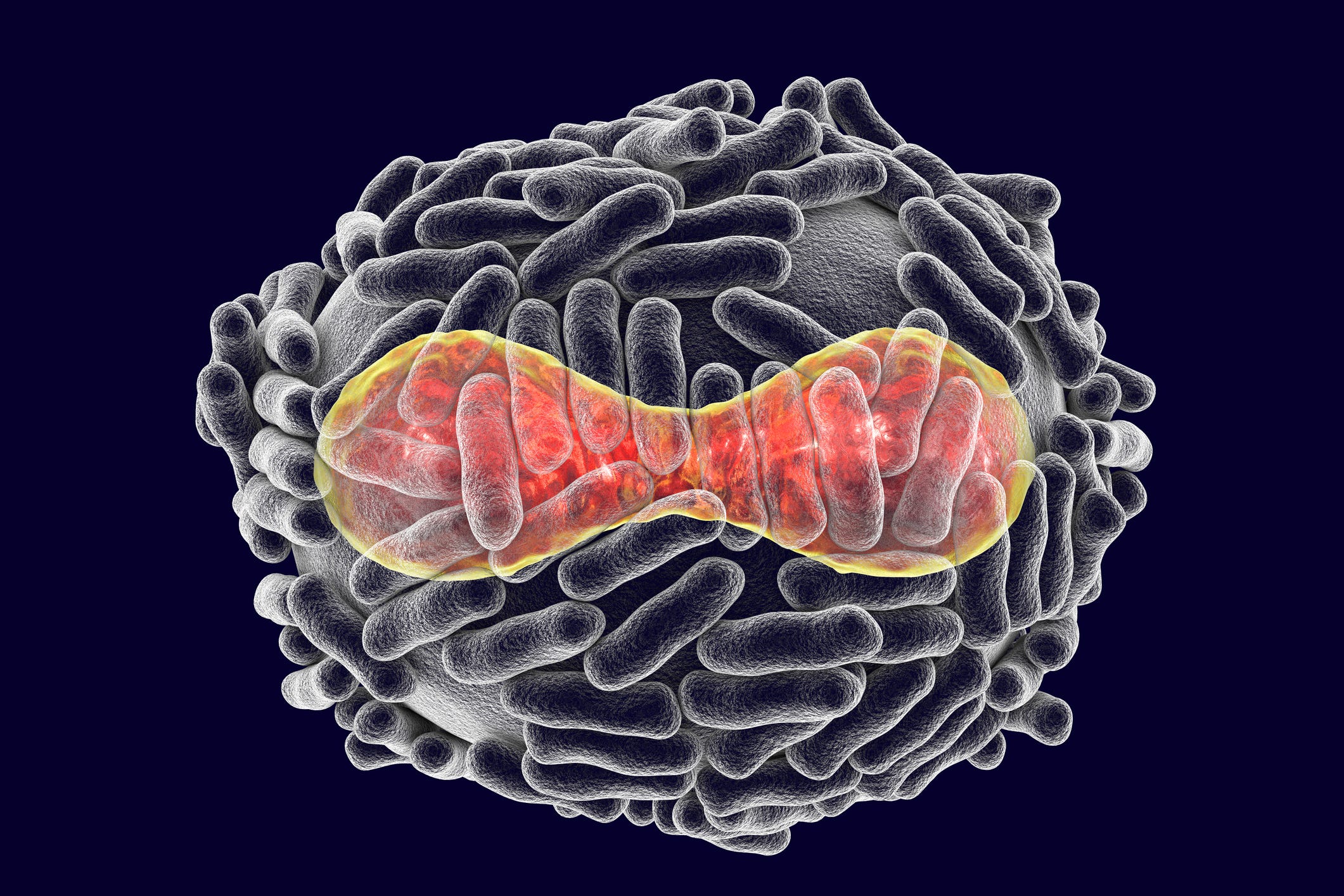
And then we kept some.
The plan, originally, was to destroy the last stocks. A date was set for 1993. It slipped to 1999, then to 2002, and the World Health Assembly has gone on postponing the execution every few years since, because each time the question comes up, some committee of experts decides that the most dangerous pathogen in human history is still useful to have around, in case someone else has secretly kept theirs. The deadliest external enemy our species ever faced now exists on Earth only because we choose, repeatedly, in a conference room in Geneva, not to let it go.
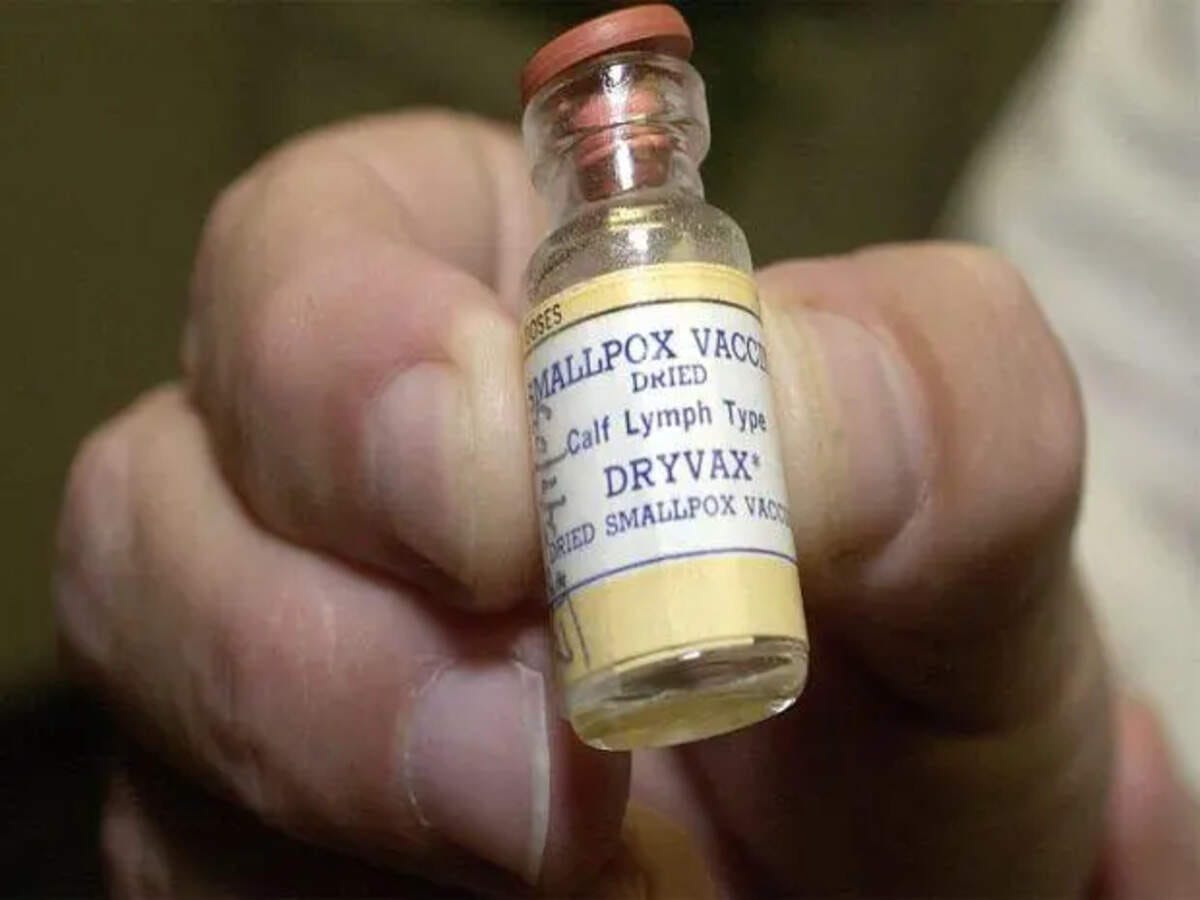
That is the whole predicament in two freezers. We did not fail to defeat our ancient enemies. We defeated them so completely that the only versions left are the ones we maintain ourselves. The threat that used to come at us from the dark of the world now comes from inside the building, kept at minus a hundred and fifty degrees, on purpose, by us.
The question everyone keeps asking is why we are letting the world spiral out of control. It is the wrong question, and the freezers explain why.
The Wheel That Was Never There
To say the world is spiralling out of control is to imagine that someone, at some earlier point, had it under control and then let go. It pictures a pilot who fell asleep, a driver who took his hands off the wheel. The image is consoling because it implies a wheel. Find the sleeping pilot, wake him, and the spiral resolves.
There is no pilot. There was never a wheel. What looks from a distance like one great machine veering toward a cliff is, up close, several billion people each making locally sensible decisions that aggregate into something no one chose and no one can stop. This is not a metaphor; it is the precise mechanism, and it has a name old enough to predate every threat we are frightened of. The fisherman who takes one more boat onto a collapsing fishery is not stupid. He can see the stocks falling. He also knows that if he leaves the fish in the water, the next boat takes them instead, and he goes home with nothing while the fishery collapses anyway. Restraint earns him only the loss. So he fishes, and so does everyone, and the rational sum of all that individual good sense is an empty sea.
Every man-made catastrophe runs on this engine. No country can disarm its nuclear weapons without handing leverage to the country that keeps its own, so all of them keep theirs, and the warheads stay on the boards by the logic of each player acting wisely. No firm racing to build the most powerful artificial intelligence can afford to slow down for safety, because slowing down only means a less careful competitor arrives first, so none of them slows down, and they say so openly, almost plaintively, as though describing weather. The carbon stays in the air because the cost of removing it falls on whoever moves first, and the benefit is shared by everyone, including those who never move at all. Each actor is behaving exactly as a clear-eyed analyst would advise. The wreck is not a failure of the reasoning. The wreck is what the reasoning produces.
And the same logic runs in reverse, which is the maddening part. It is not only that no one will set the danger down first. No one will pick the solution up first either. Take the promise held out by hydrogen, a fuel that burns to water and could in principle run the heavy industry and the long-haul shipping that batteries struggle to reach. Whether or not it proves the right bet in the end, notice what actually stops it. Someone has to spend enormously, first and alone, to build the plants and the pipelines before any of it becomes cheap and ordinary for everyone who held back. And no one will, because whoever moves first eats the cost while everyone who waits arrives later to a finished technology and free-rides on the losses. Even Toyota, which bet on hydrogen more publicly than any of its rivals, has quietly hedged back into the batteries it spent years playing down. The expensive first step never comes, and a solution that might work for all of us sits unbuilt because it would pay off for its builder last.
None of this means we are simply incapable of steering. We are, sometimes, spectacularly capable of it. We eradicated smallpox through the coordinated efforts of more than a hundred governments over two decades and the bitterest stretch of the Cold War. We found a hole in the ozone layer and closed it, banning the chemicals responsible for it almost everywhere on Earth within a few years. But look at when the steering works. No nation profited from keeping smallpox in circulation. No industry’s survival depended on the banned refrigerants once a substitute had been found. The wheel appears precisely in those cases where turning it costs the person turning it nothing. Where holding back means handing the advantage to whoever refuses to hold back, the wheel is not there to be found, and that describes every danger that actually keeps us awake.
This is why “why are we letting it happen” never gets a satisfying answer. The question hunts for a culprit, a committee that voted for the spiral, a hand that should have been on the wheel. But there is no “we” that decides these things, only a vast number of “I”s “ each doing the sensible thing in front of them. The catastrophe is not a betrayal of human rationality. It is human rationality, scaled up past the point where any single rational person can change the outcome by being good.
Every Threat Is a Trophy
Notice what all of our new enemies have in common. The bomb is the physics that ended the largest war in history. The warming climate is the cheap energy that ended famine across whole continents and allows a baby born today to expect to outlive its great-grandparents by decades. The engineered pathogen is the same molecular biology that eradicated smallpox, and that built the vaccine platforms which met the last pandemic in months rather than years. The runaway intelligence is the thinking machine we built to do our thinking for us. Each existential risk is a solved problem viewed from behind.
This is the part the spiral story misses entirely, because the spiral story needs the threats to be mistakes, wrong turns, things we could have avoided with more wisdom. They are not mistakes. They are triumphs with a second face. We did not stumble into the capacity to destroy ourselves. We earned it, step by step, by getting very good at exactly the things that kept us alive.
And here is the unwelcome bit, the thing that makes the whole arrangement feel less like a problem to be managed and more like a trap with no clean exit. You cannot unbundle the two faces. The knowledge that lets you sequence a virus to defeat it is the knowledge that lets you build one. There is no version of synthetic biology that only heals. The reactor that powers a city and the device that levels one are separated by engineering choices, not by different sciences. We keep the last smallpox in the freezer precisely because the expertise to fight it and the expertise to weaponise it are the same expertise, so destroying the virus would not destroy the danger, only our readiness for it. The dual use is not a flaw in the technology that better governance could file away. It is the structure of capability itself. To be able to do a thing is to be able to do its opposite, and we have spent ten thousand years becoming able to do almost everything.
We keep the last smallpox to guard against smallpox, which is the whole trap in a sentence: the defence and the danger are the same object, and getting rid of one means getting rid of the other.
So the relentless, expansionary, problem-solving drive that carried us through every external test cannot simply be switched off for the dangerous problems while left running for the safe ones. It is one faculty, not two. The same restlessness that cured the plague is the restlessness that will not leave the last of it alone. We are very good at solving things. That is the diagnosis, not the cure.
And the trap of the earlier section now shows its other half. We cannot stop building the danger, because the building is the same act as the thriving. We cannot agree to set down what we have built, because whoever sets it down first only loses to whoever does not. Capability supplies the threat. Incentive guarantees we keep it.
The Animal That Cannot Feel the Number
Even setting aside the trap of incentives, there is a second failure underneath it, and it lives in the body rather than the game theory.
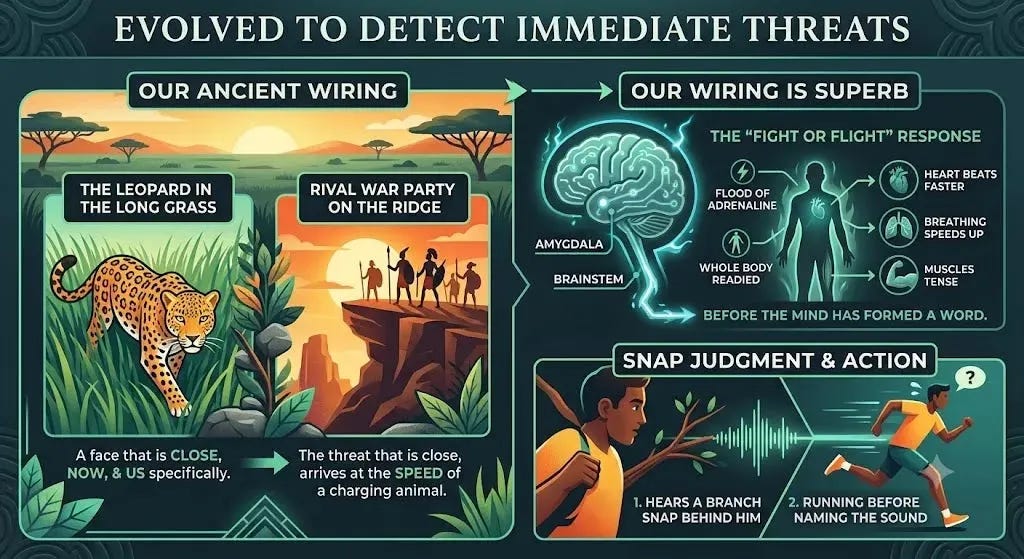
We were built, over a few million years, to detect a particular kind of threat. The leopard in the long grass. The rival war party on the ridge. The threat that has a face, that is close, that is now, that means us specifically and arrives at the speed of a charging animal. Against that threat our wiring is superb. The flood of adrenaline, the whole body readied before the mind has formed a word. A human being who hears a branch snap behind him will be running before he can name what he heard.
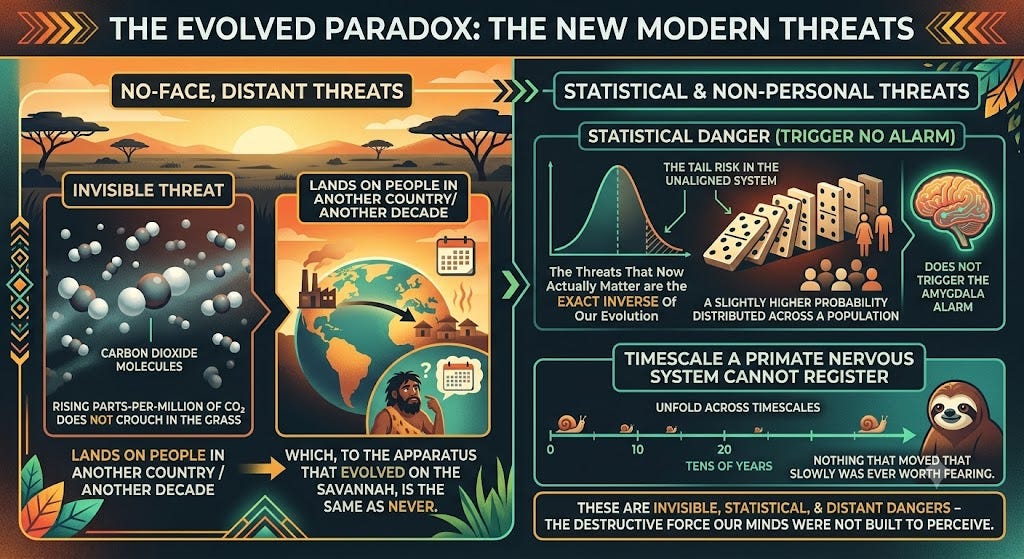
The threats that now actually matter are the exact inverse of that. They have no face. A rising parts-per-million of carbon dioxide does not crouch in the grass. They are not close. The worst of the warming, the tail risk in the unaligned system, lands on people in another decade or another country, which to the apparatus that evolved on the savannah is the same as never. They are not now. They unfold across timescales a primate nervous system simply cannot register as urgent, because nothing that moved that slowly was ever worth fearing. And they are statistical rather than personal. They do not mean you. They mean a slightly higher probability distributed across a population, which is precisely the form of danger that triggers no alarm at all.
The proof of this mismatch is sitting in everyone’s pocket. We will drop everything for a single named child trapped down a well, mobilise a nation, run rolling coverage, and we will scroll past the statistic that a thousand anonymous children died that morning of causes we could prevent for the price of the news van. This is not hypocrisy. It is hardware. The one child has a face and the thousand have a number, and we are an animal that can feel a face and cannot feel a number.
You could object that we managed it once. When COVID arrived it was, for a few months, the very thing we are built to fear. It was now, doubling in days while the bodies were still warm. It was close, coming for your own street and not someone else’s a decade out. It wore a face almost at once, the grandmother on the ventilator and the refrigerated trucks parked
outside hospitals in cities we recognised. And it was personal, which is to say it meant you, and everyone you were frightened of losing. It met every condition our wiring answers to, so the world did the thing it is forever told it cannot do. It stopped. And then watch what became of all that resolve the moment the virus slowed into a background statistic, a few hundred a day and mostly the old. The response did not taper. It collapsed, while the dying went on, because the threat had stopped wearing a face and gone back to being a number. That is not the exception to the rule. It is the rule, filmed in time-lapse.
Every existential risk we face wears the number and not the face. They are, every one of them, exactly the shape of danger our threat-detection was designed to ignore. We are not asleep at the wheel. We are wide awake and watching the wrong horizon, because the horizon we are built to watch is the one where the leopards used to come from, and the leopards are extinct, and we drove them to it.
We Were Only Ever Shown One Column
There is a now-familiar genre of correction aimed at exactly the mood the question comes from, and it deserves to win its argument before I take it apart. The world, it points out, is on almost every measure that touches an ordinary life getting steadily, dramatically better. Extreme poverty has collapsed within a single generation. A child born today will, on average, live decades longer than one born when its grandparents were young, and is far less likely to die before its fifth birthday or to be killed by another human being. The person who is certain civilisation is sliding into the abyss is, on these numbers, mistaken, and the people who keep producing the charts are right to keep producing them. The trend is real and up.
But the trend is one column, and progress was always written in two.
The optimist’s chart measures the central case, the average life and the line drawn through the middle of the data. What it does not measure is the tail. It does not measure the worst thing that can now happen, or how few hands are now required to make it happen. For almost the whole of human history, those two columns moved together, and both stayed small. The upside was modest and local, a good harvest or a generation without war. The downside was terrible and local too: a bad king ruined a kingdom, a plague emptied a province, and then it burned out at a border or ran its course, because there was a ceiling on how much harm any person or any pathogen could do, set by the plain physics of how far a horse could ride and how fast a fire could spread.
That ceiling is gone, and it went in living memory. Forty-two years separate the first powered flight from the atomic bomb. We compressed the entire distance between a human being leaving the ground and a human being erasing a city into a span shorter than one working life. And the floor has kept dropping ever since. The number of people required to author a catastrophe that reaches everyone has been falling without pause for 80 years. It once took an empire. Then it took one of two superpowers. The clear direction of travel is toward a world where it takes a well-funded laboratory, or a single determined grievance with access to the right software.
So the pessimist is not suffering from nostalgia, and is not, whatever the optimist implies, merely bad at reading graphs. The pessimist is reading the second column, the one the cheerful charts leave off, and the second column genuinely has tipped. The sense that something has changed for the worse at the root is not a failure of perspective. It is an accurate report on the one quantity that the reassuring statistics are built not to show. People’s lives are better than their grandparents’ lives. The worst case suspended over those lives is larger than anything their grandparents could have pictured. Both are true at once, and the body, for the reasons of the previous section, tracks the second and not the first.
This is what the tipping point actually is, and why it is neither the collapse the pessimist fears nor the illusion the optimist diagnoses. Nothing reversed. The line of ordinary life is still climbing. What happened is that the worst case crossed over from bounded to unbounded, from something that stopped at a border into something that does not stop, and a species whose alarm is tuned to the catastrophic exception rather than the gradual rule felt that crossing was a turn for the worse, because in the only sense its nervous system can measure, it was one.
And the final twist, the one that forecloses any hope of keeping the good column and quietly deleting the bad, is that the two are not separate accounts. They are produced by the same act. The engine that lifts the line of ordinary life, the patient accumulation of knowledge, and the relentless cheapening of our power over the physical world are the identical engine that drops the floor out from under the worst case. You do not get the longer lifespan without the laboratory that can also brew the plague, or the abundant energy without the abundant means of destruction. The upside and the downside are not a force and its unfortunate by-product. They are one motion seen from both ends, and we were shown only the encouraging end for so long that the other now reads as a betrayal rather than what it is: the bill.
Eighty-Five Seconds
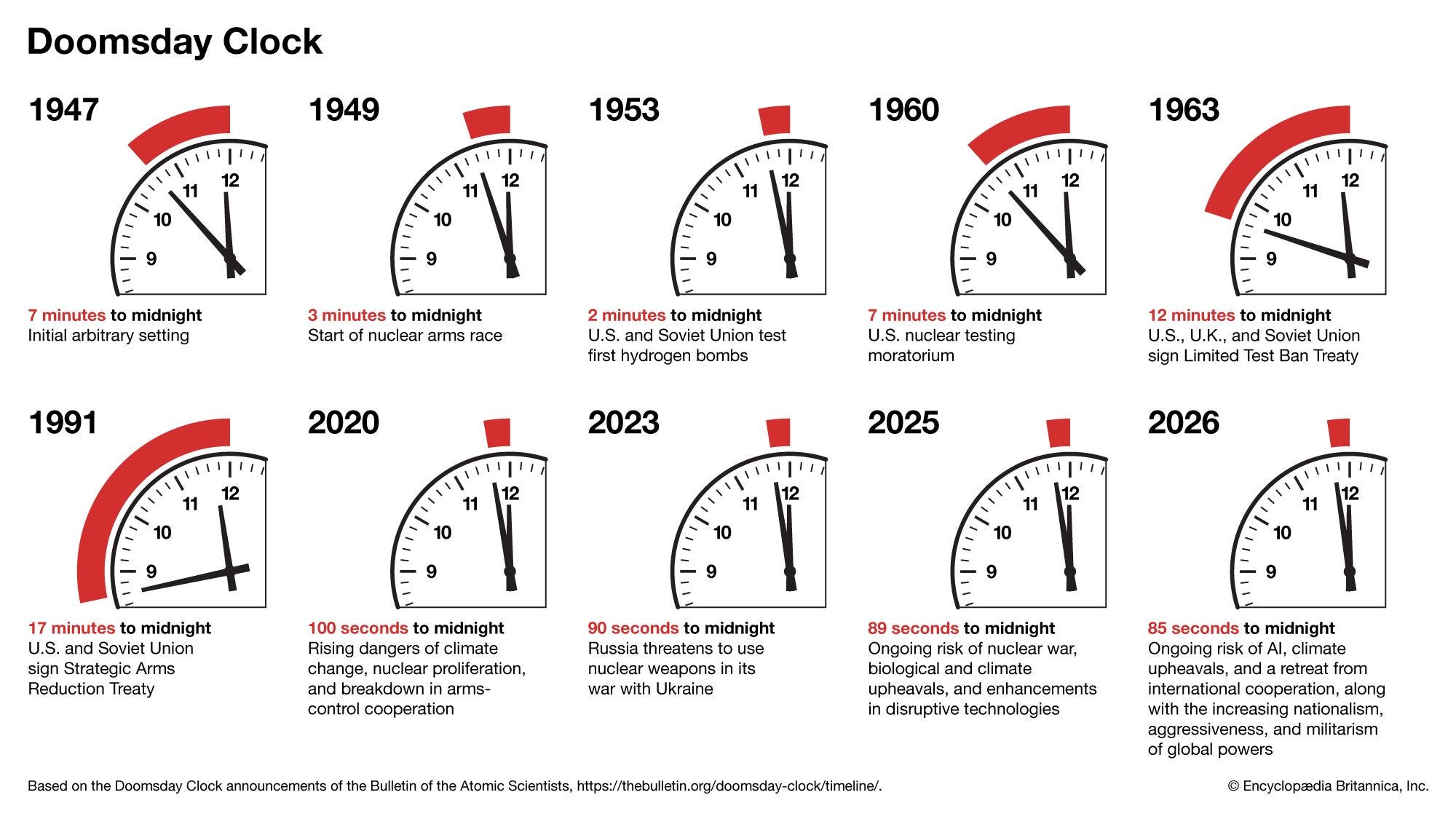
The Doomsday Clock, the one the atomic scientists have been keeping since 1947, now stands at eighty-five seconds to midnight. It has never been closer. The scientists who set it have stopped saying minutes, because minutes no longer reflect the situation, and they describe what threatens us with a phrase worth holding up to the light. Technologies of our own making. Not the asteroid, not the indifferent violence of a universe that spent most of our history trying to kill us and several times very nearly managed it. Our own making. The clock measures, more than anything, the distance between what we can do and what we can stop ourselves doing, and that distance is now eighty-five seconds wide.
I keep returning to the freezers. To the simple, repeated, almost bureaucratic fact of them. Every few years, the experts gather, and the question comes round again: kill the last of it or keep it, and every few years, the answer is the same. Keep it. We might need it. Someone else might have kept theirs. The reasoning is impeccable at every step, which is exactly the problem, because impeccable reasoning is what put the virus in the freezer and impeccable reasoning is what keeps it there, and there is no point in the chain where a wiser person could have said the obvious thing and been listened to. We beat the worst enemy we ever had. And then, with the full and careful deliberation of a species that prides itself on its intelligence, we declined to finish it off.
The freezer in Atlanta is still humming. The freezer in Koltsovo is still humming. The vote to switch them off has been scheduled, missed, and scheduled again for thirty-three years.
☕ Love this content? Fuel our writing!
Buy us a coffee and join our caffeinated circle of supporters. Every bean counts!
I have to agree with you. I see no exit from this trap. But as this summer continues, I feel repercussions coming rapidly, no longer slowly.